7 Ways to Ship Supplements in Europe and Grow Your Shopify Brand
7 Ways to Ship Supplements in Europe and Grow Your Shopify Brand
Selling supplements through Shopify can be a strong ecommerce opportunity, but shipping supplements in Europe requires more planning than shipping ordinary consumer products.
Vitamins, minerals, protein powders, capsules, gummies, and other food supplements are subject to specific EU food and labeling requirements. EU rules also regulate what can be claimed about a supplement and how products are presented to consumers.
For Shopify brands, the challenge is therefore not simply:
“How do I ship a supplement from A to B?”
It is:
“How do I move compliant products through the supply chain efficiently while keeping delivery costs, inventory, and customer experience under control?”
Here are 7 practical ways to ship supplements in Europe and build a more scalable Shopify fulfillment strategy.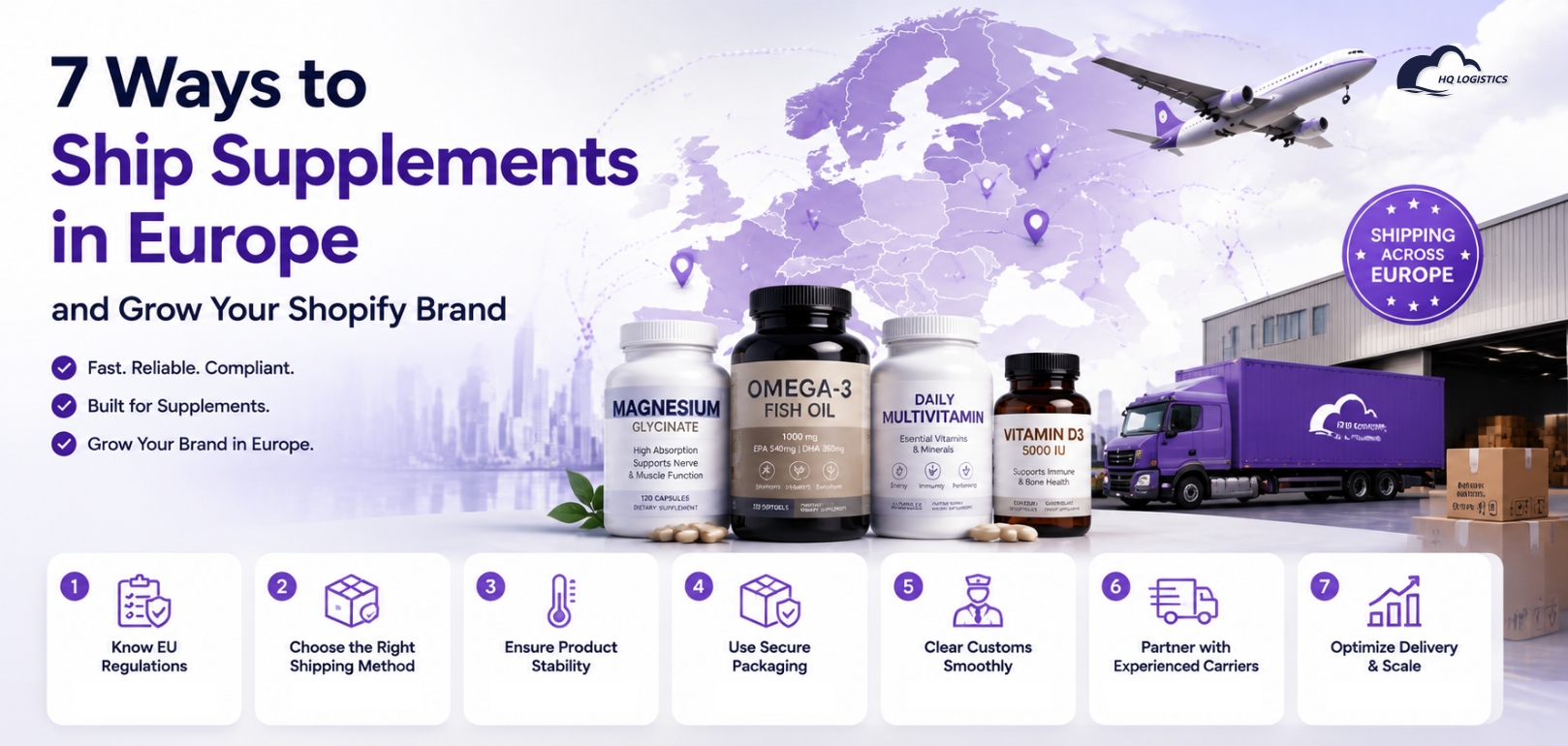
1. Use EU-Based Fulfillment for Faster Local Delivery
One of the most effective ways to improve supplement shipping is to position inventory closer to your customers.
Instead of shipping every order individually from China or another non-EU origin, Shopify brands can place popular SKUs in an EU fulfillment warehouse.
The basic model is:
Supplier → EU Warehouse → Shopify Order → Pick & Pack → Local/Regional Delivery
This can reduce the distance between inventory and customers and make fulfillment easier to manage as order volume grows.
EU fulfillment is particularly useful for brands selling repeatedly into markets such as:
Germany | France | Netherlands | Belgium | Spain | Italy | Austria | Poland | Sweden | Denmark
Rather than treating Europe as one shipping destination, brands can use inventory data to determine where their biggest customer groups are located.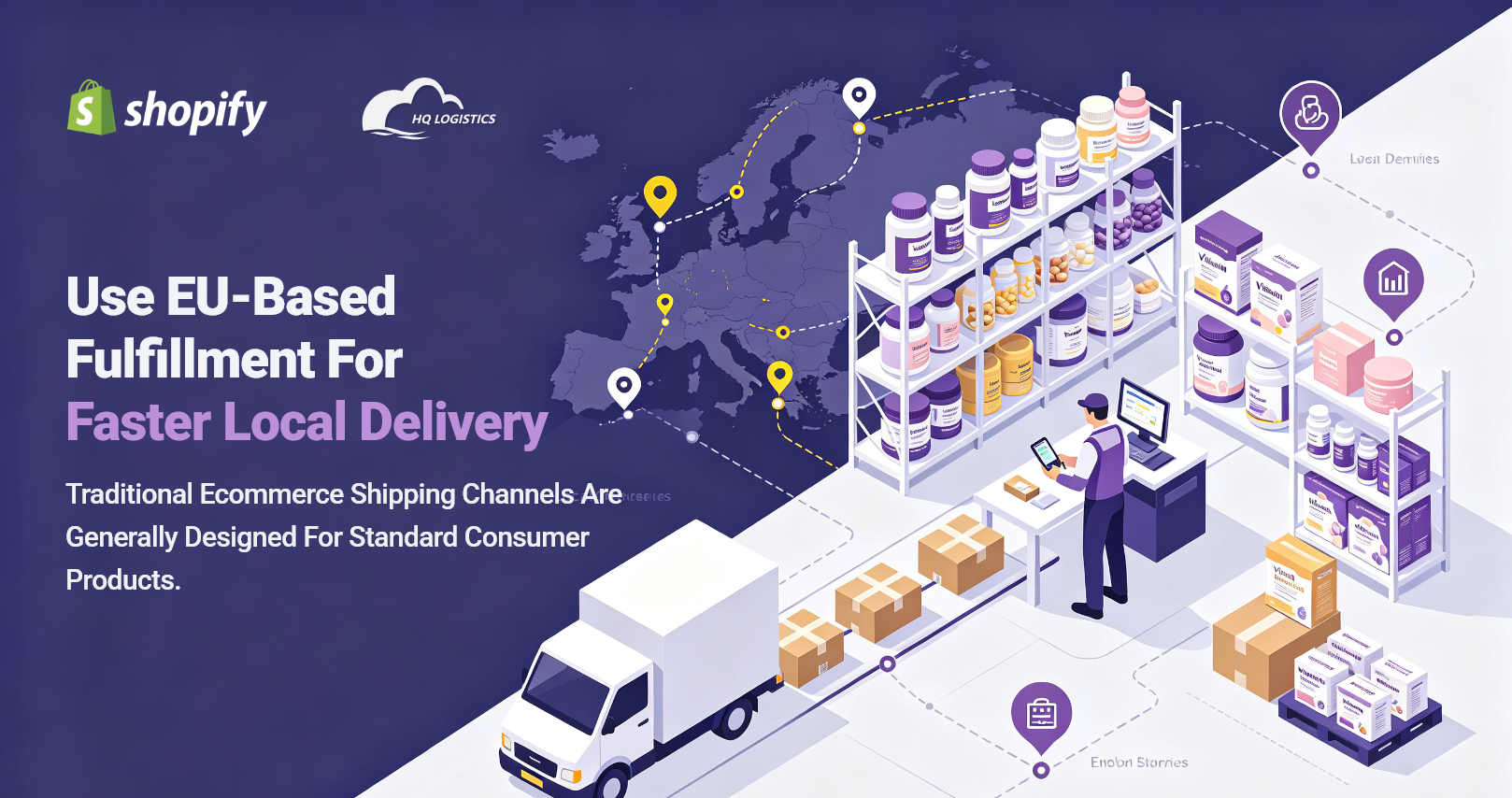
2. Choose Shipping Routes Based on Product and Market
There is no single shipping method that is best for every supplement order.
A Shopify brand should consider:
Destination | Product weight | Order value | Delivery expectations | Inventory location | Customs requirements | Shipping cost
For example, a lightweight bottle of capsules may be suitable for a different shipping solution than a large container of protein powder.
You can structure your shipping strategy around several options:
Direct international shipping | EU warehouse fulfillment | Postal services | Express shipping | Dedicated lines | Local delivery networks
The goal is not simply to find the cheapest carrier.
The goal is to find the best balance between cost + delivery speed + reliability + compliance.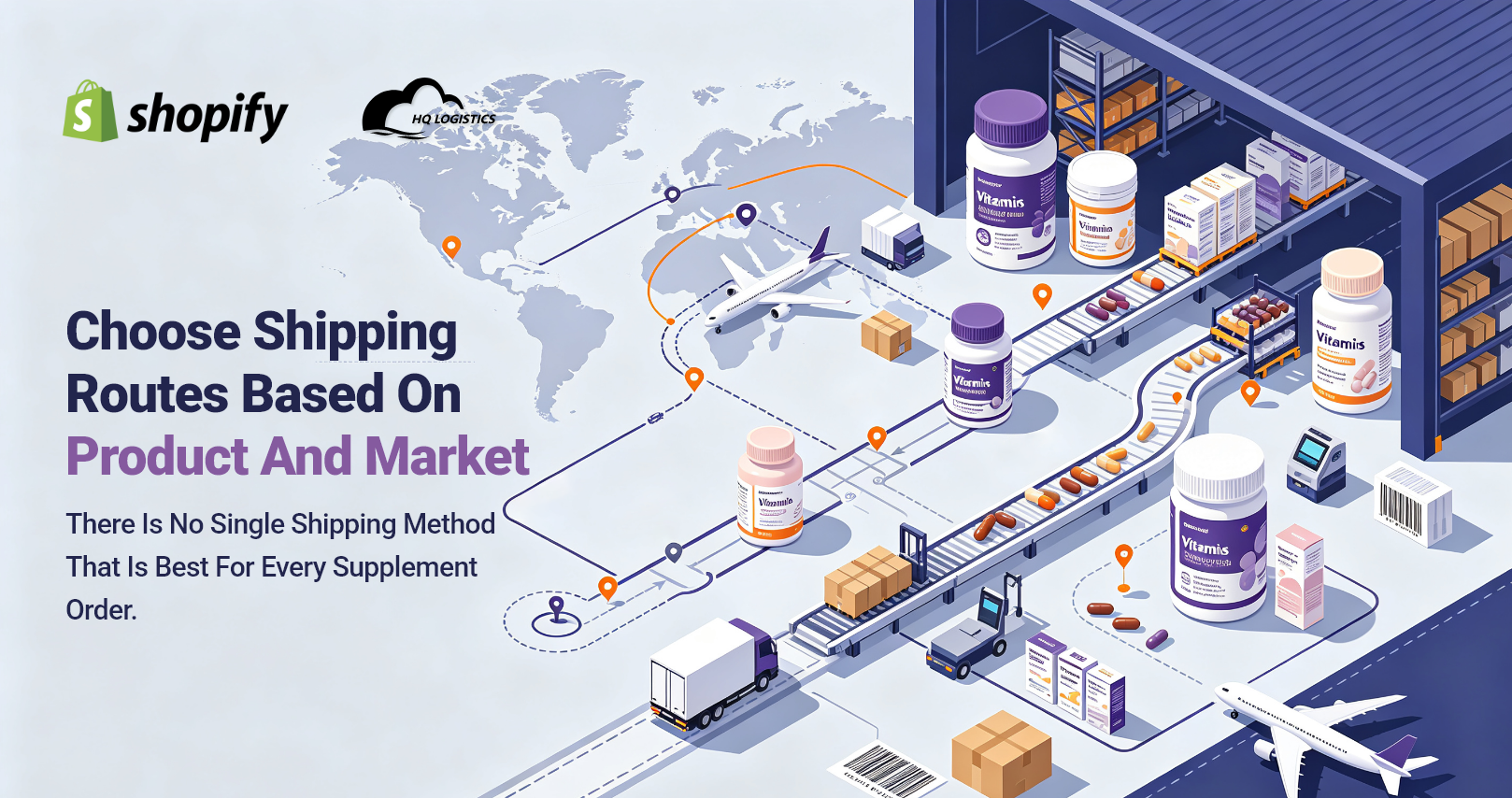
3. Use a DDP Strategy When Appropriate
For cross-border supplement shipments, customs and taxes can create friction for both the seller and customer.
A Delivered Duty Paid (DDP) approach can make the checkout and delivery experience more predictable when the route and product are eligible and the relevant tax/customs requirements are correctly handled.
Instead of the customer unexpectedly dealing with import charges, the logistics process is structured so that applicable duties and taxes are handled within the shipping arrangement.
For Shopify brands, this can help create a smoother customer experience.
However, DDP does not remove product compliance responsibilities.
Food supplements sold or imported into the EU still need to comply with applicable EU rules. 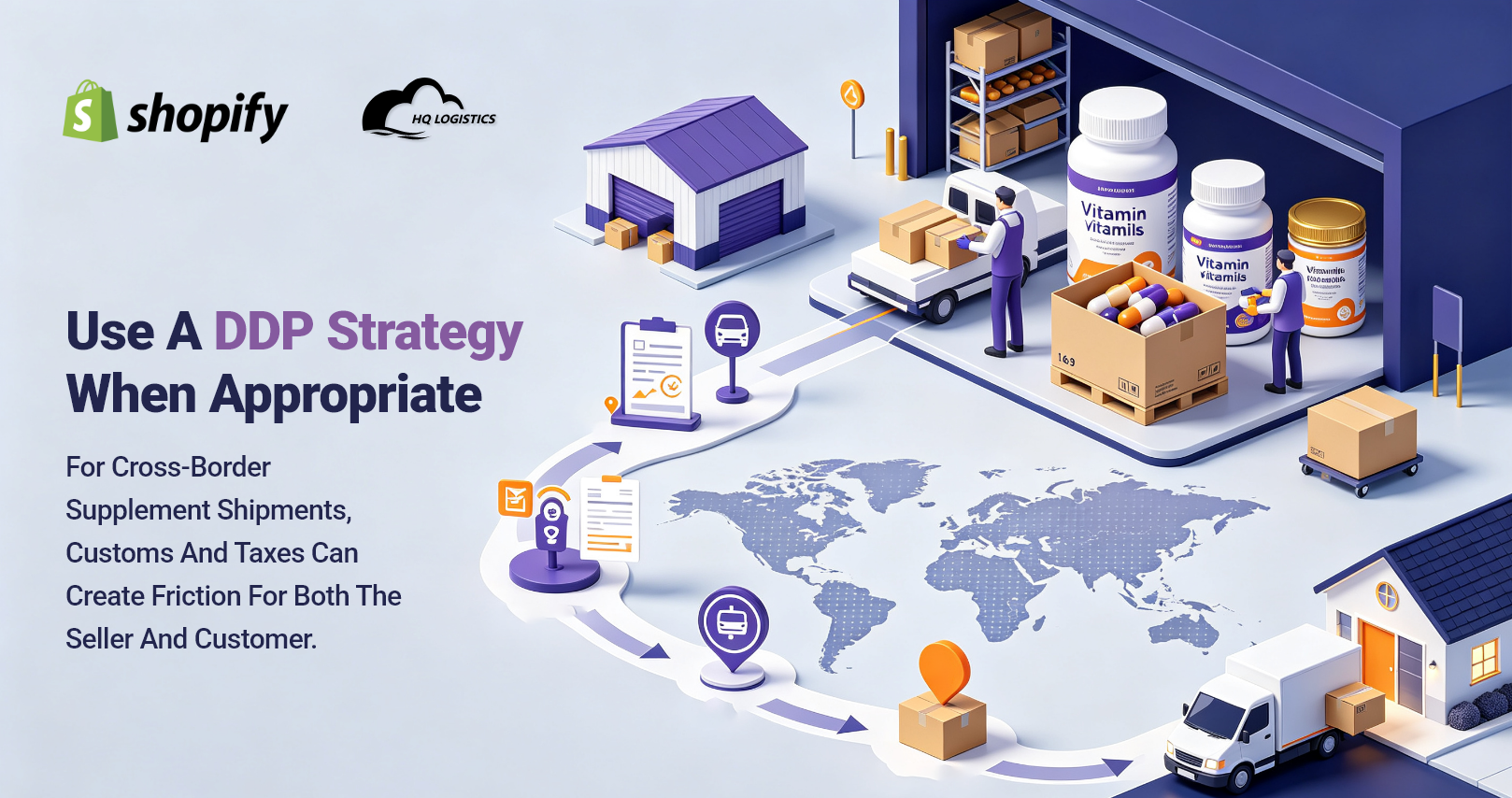
4. Build a Country-Specific Supplement Shipping Strategy
Europe is not a completely uniform supplement market.
Although EU-level rules provide a common framework, businesses should still review the requirements applicable to each target market, including national requirements and competent-authority procedures. EU countries can require notification of food supplements placed on their market.
This means your logistics strategy should consider the individual market.
For example:
Germany → France → Netherlands → Spain → Italy → Sweden
may all require different operational considerations around product information, language, notification, taxes, delivery, and customer expectations.
A scalable Shopify brand should therefore maintain a country-level shipping matrix covering:
Country | Warehouse | Shipping Method | Estimated Delivery | Tax/Customs Model | Product Restrictions | Label Requirements
This makes it much easier to expand into additional European markets.
5. Keep Inventory Close to Your Best-Selling Markets
Shipping faster is not always about choosing a faster carrier.
Sometimes the biggest improvement comes from moving inventory closer to demand.
Suppose your Shopify store generates most of its European orders from Germany, France, and the Netherlands.
Instead of keeping all inventory in China, you could evaluate whether placing appropriate stock in an EU warehouse makes economic sense.
Your inventory strategy could look like:
China Sourcing → Bulk Shipment → EU Warehouse → Multi-Country Fulfillment
This can also make replenishment easier.
The key is to avoid putting every SKU into the EU warehouse.
Start with:
Best Sellers | High-Margin Products | Fast-Moving SKUs | Stable Demand Products
Then gradually expand the SKU range as sales data supports it.
6. Make Compliance Part of Your Fulfillment Process
This is one of the most important differences between supplements and ordinary ecommerce products.
EU rules require food supplements to comply with specific labeling requirements. For example, supplement labeling must include the recommended daily portion, a warning not to exceed the recommended dose, a statement that supplements should not replace a balanced diet, and a statement to keep them out of the reach of young children.
Claims are also important.
Supplement labeling, presentation, and advertising cannot claim that a product prevents, treats, or cures a disease. Nutrition and health claims are subject to EU rules and must meet applicable requirements.
This means your fulfillment workflow should include checks for:
Product label | Ingredients | Batch information | Expiry date | Packaging | Required warnings | Product documentation | Country-specific requirements
Quality control should happen before products enter your sellable inventory, not after a customer receives them.
This is especially important because EU authorities have recently increased scrutiny of supplements sold through ecommerce channels. In a 2025 EU control operation covering 3,474 food supplement consignments, 63% were found to be non-compliant in the sample checked. 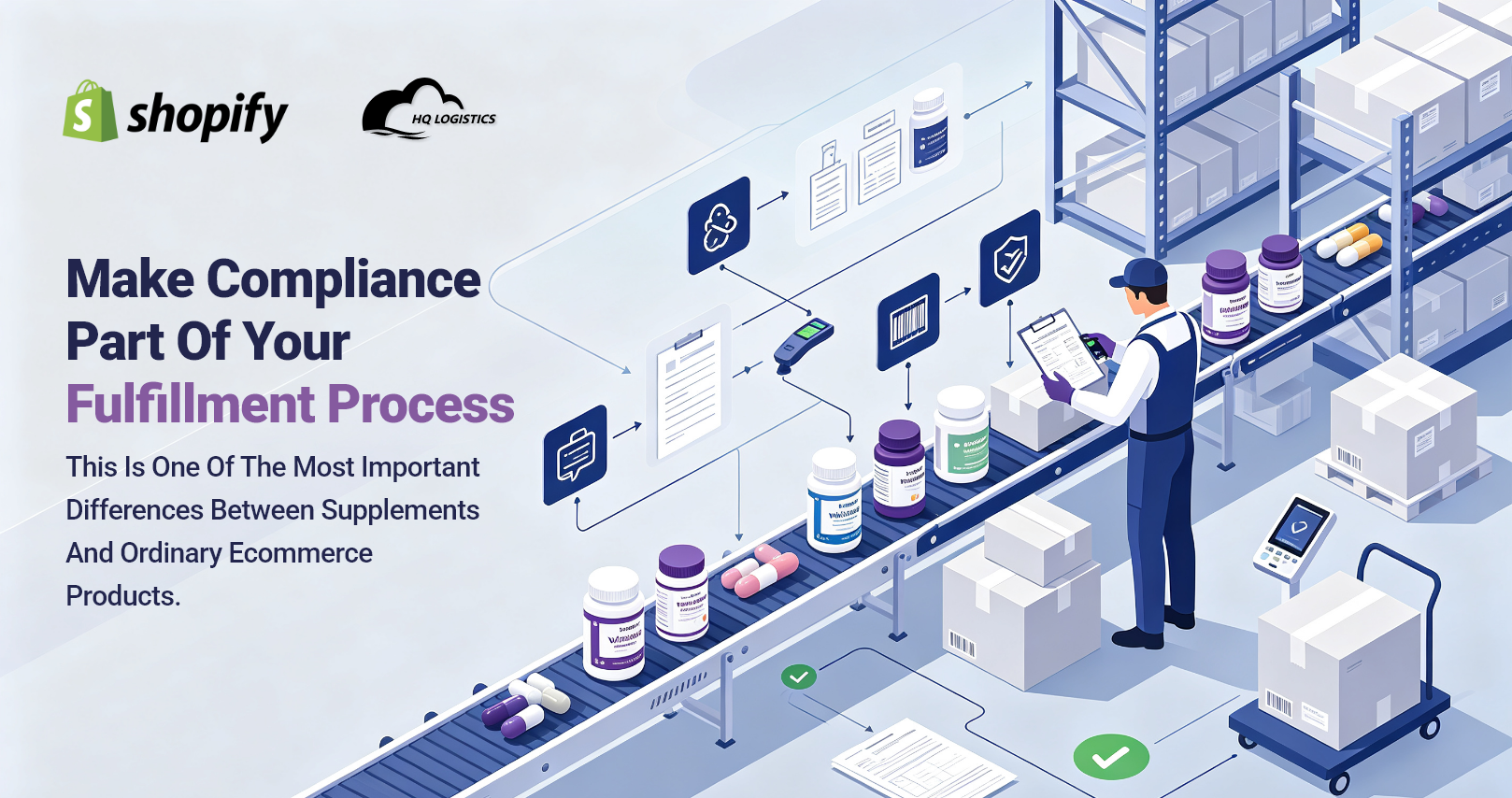
7. Connect Shopify, Inventory, and Fulfillment
Shipping supplements efficiently becomes much easier when your ecommerce and logistics systems are connected.
A growing Shopify brand may have:
Shopify Store | Supplier | Warehouse | WMS | Shipping Provider | Tracking System | Customer Service
If these systems are disconnected, inventory and order management can quickly become complicated.
An integrated fulfillment setup can automate:
Shopify Order → Inventory Check → Warehouse Allocation → Pick & Pack → Shipping Label → Tracking Sync → Customer Notification
This provides better visibility into:
Inventory Levels | Orders | Shipment Status | Replenishment | Returns | Warehouse Performance
For supplement brands, this is especially valuable because many products have batch numbers, expiry dates, and specific storage requirements that need to be managed carefully.
How to Choose the Right Supplement Shipping Strategy
Before choosing a logistics model, look at your business from four angles.
Product
Capsules | Tablets | Gummies | Powder | Liquid supplements | Protein products
Different product formats can have different packaging, weight, storage, and shipping considerations.
Market
Germany | France | Netherlands | Spain | Italy | Nordics | UK
Consider where your customers are located and whether local inventory would improve your economics.
Order Volume
1–10 orders/day | 10–50 orders/day | 50–200 orders/day | 200+ orders/day
The right fulfillment model can change significantly as order volume grows.
Inventory
Single SKU | Multiple SKUs | Multiple product variants | Multiple batches
The more complex your inventory becomes, the more important WMS and inventory controls become.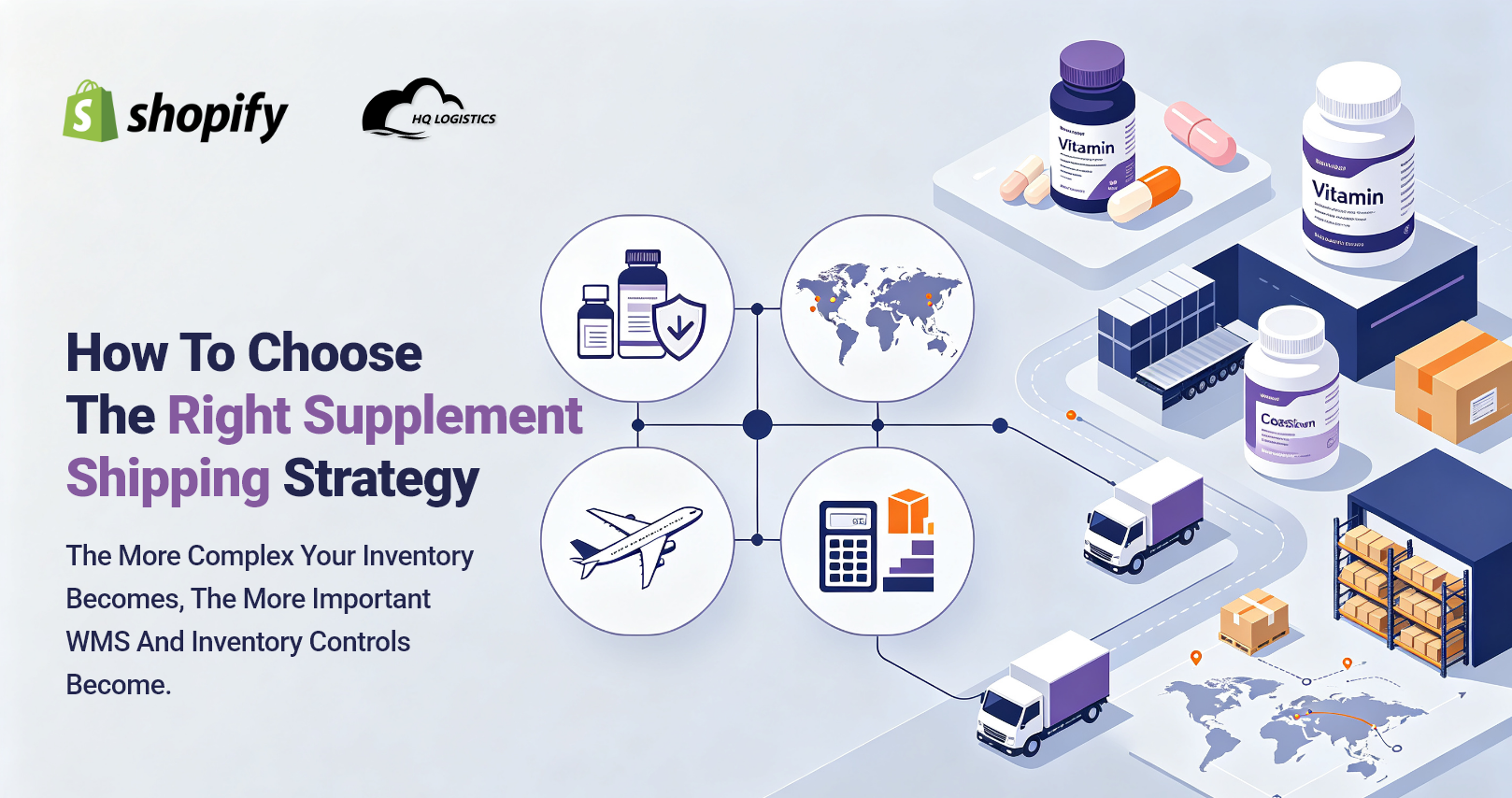
A Better Shipping Model for Growing Shopify Supplement Brands
For a small Shopify supplement store, direct shipping may be enough.
But as the business grows, a more scalable model could be:
China Sourcing → Product & Quality Control → Bulk Transportation to Europe → EU Fulfillment Warehouse → Shopify Order Integration → Automated Pick & Pack → Local/Regional Shipping → Real-Time Tracking
This model can combine sourcing, inventory management, fulfillment, and logistics instead of treating shipping as a separate operation.
Don't Forget Product Expiry Dates
Supplements are different from many other ecommerce products because inventory has a shelf-life consideration.
Holding too much inventory can create a problem even if the product continues to sell.
A good inventory strategy should monitor:
Batch Number | Production Date | Expiry Date | Stock Quantity | Sales Velocity | Remaining Shelf Life
A FEFO (First Expired, First Out) approach can help ensure inventory with the earliest expiry date is prioritized for fulfillment where appropriate.
This is another reason why supplement brands need more than a basic inventory spreadsheet as they scale.
How to Reduce Supplement Shipping Costs in Europe
Shipping cost optimization should start before the order reaches the warehouse.
Look at the complete cost:
Product Cost + Packaging + International Freight + Customs/Taxes + Warehouse Fees + Pick & Pack + Last-Mile Delivery + Returns
Then identify where the biggest savings are available.
For example:
Smaller Packaging → Lower Dimensional Weight
Bulk Shipping → Lower Average Transportation Cost
EU Warehousing → Potentially Shorter Last-Mile Routes
Inventory Forecasting → Fewer Emergency Shipments
Automated Fulfillment → Lower Manual Processing Costs
The cheapest shipping service is not necessarily the cheapest overall logistics strategy.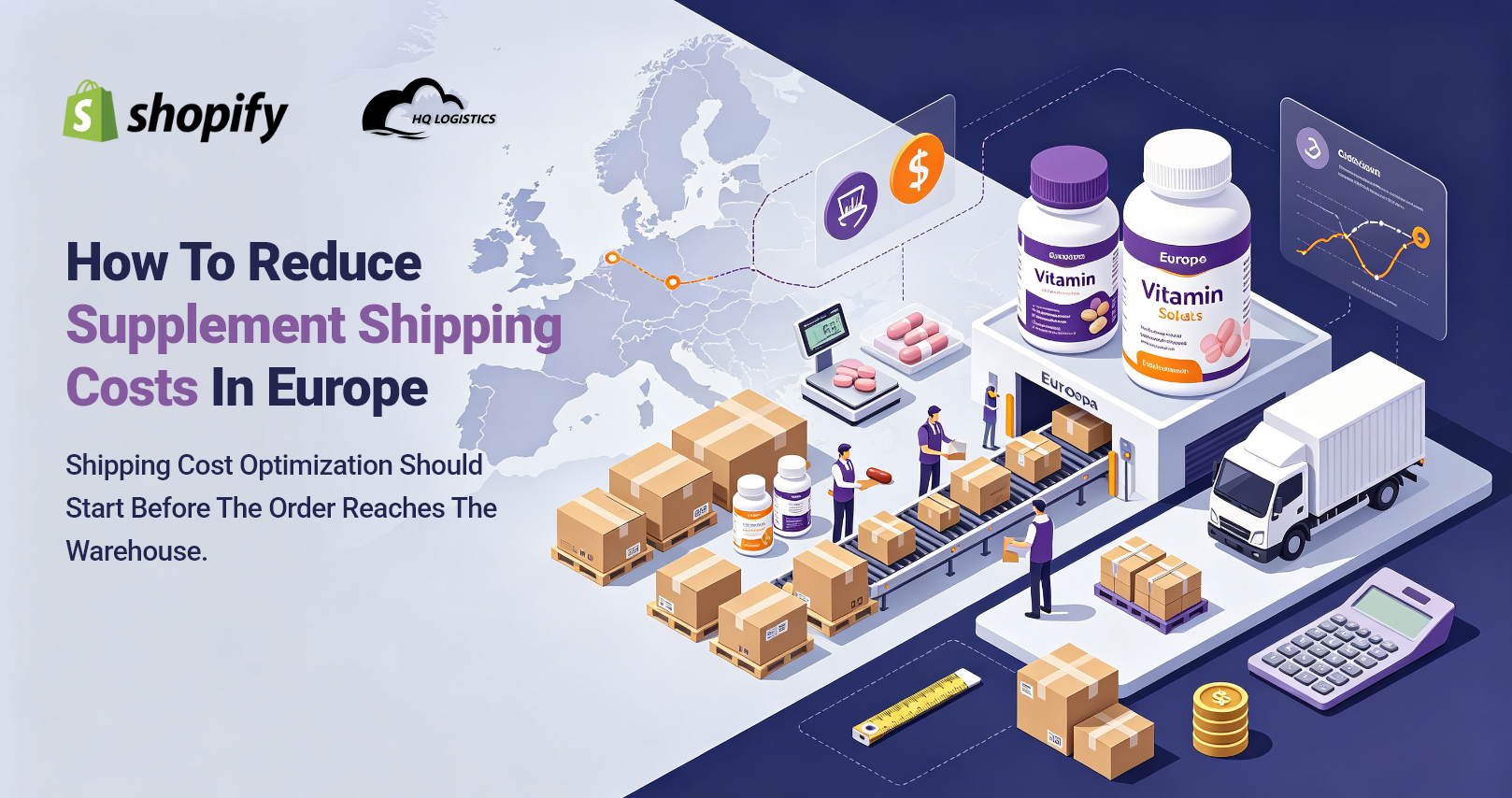
7 Ways to Ship Supplements in Europe: Quick Summary
1. EU-Based Fulfillment | Keep popular products closer to European customers.
2. Multi-Route Shipping | Match shipping methods to destination, product, cost, and delivery expectations.
3. DDP Shipping | Where appropriate, use a properly structured DDP solution to create a more predictable cross-border delivery experience.
4. Country-Specific Planning | Build shipping and compliance processes around individual European markets.
5. Localized Inventory | Position fast-moving products closer to your biggest customer markets.
6. Compliance-First Fulfillment | Check labels, ingredients, warnings, documentation, batches, and expiry dates before products enter sellable stock.
7. Shopify + WMS Integration | Connect orders, inventory, fulfillment, and tracking into one workflow.
Final Thoughts
Shipping supplements in Europe is about much more than finding a carrier.
For a growing Shopify brand, the real challenge is building a supply chain that can handle compliance, inventory, fulfillment, customs, delivery, and customer expectations at the same time.
The strongest approach is to think beyond individual shipments.
Start with the product.
Then plan the inventory.
Choose the right fulfillment location.
Select the appropriate shipping route.
Connect Shopify with your warehouse and logistics systems.
And build compliance checks into the process from the beginning.
As your supplement brand grows, a well-designed European fulfillment and supply chain strategy can help reduce operational complexity while creating a better experience for your customers.
The goal isn't just to ship supplements to Europe. It's to build a supply chain that allows your Shopify brand to grow across Europe.
FAQs
Can I ship supplements from China directly to European customers?
Potentially, but the product must comply with the applicable EU and national requirements. Supplements are regulated as food products, and labeling, ingredients, claims, documentation, and import requirements need to be reviewed before selling.
Is EU warehousing better for supplement brands?
For brands with consistent European demand, EU warehousing can be worth evaluating because it places inventory closer to customers and can simplify fulfillment. The best model depends on order volume, product shelf life, storage requirements, and total logistics costs.
What should I check before shipping supplements in Europe?
Review ingredients | labeling | required warnings | claims | documentation | batch information | expiry dates | storage requirements | customs | country-specific requirements.
Should supplement brands use DDP shipping?
DDP can provide a more predictable cross-border delivery experience when correctly structured, but it does not replace product compliance or other regulatory obligations.
What is the best fulfillment model for a growing Shopify supplement brand?
For a small business, direct shipping may be sufficient. As order volume grows, a model combining China sourcing + quality control + EU warehousing + Shopify integration + automated fulfillment + regional shipping can provide greater scalability.