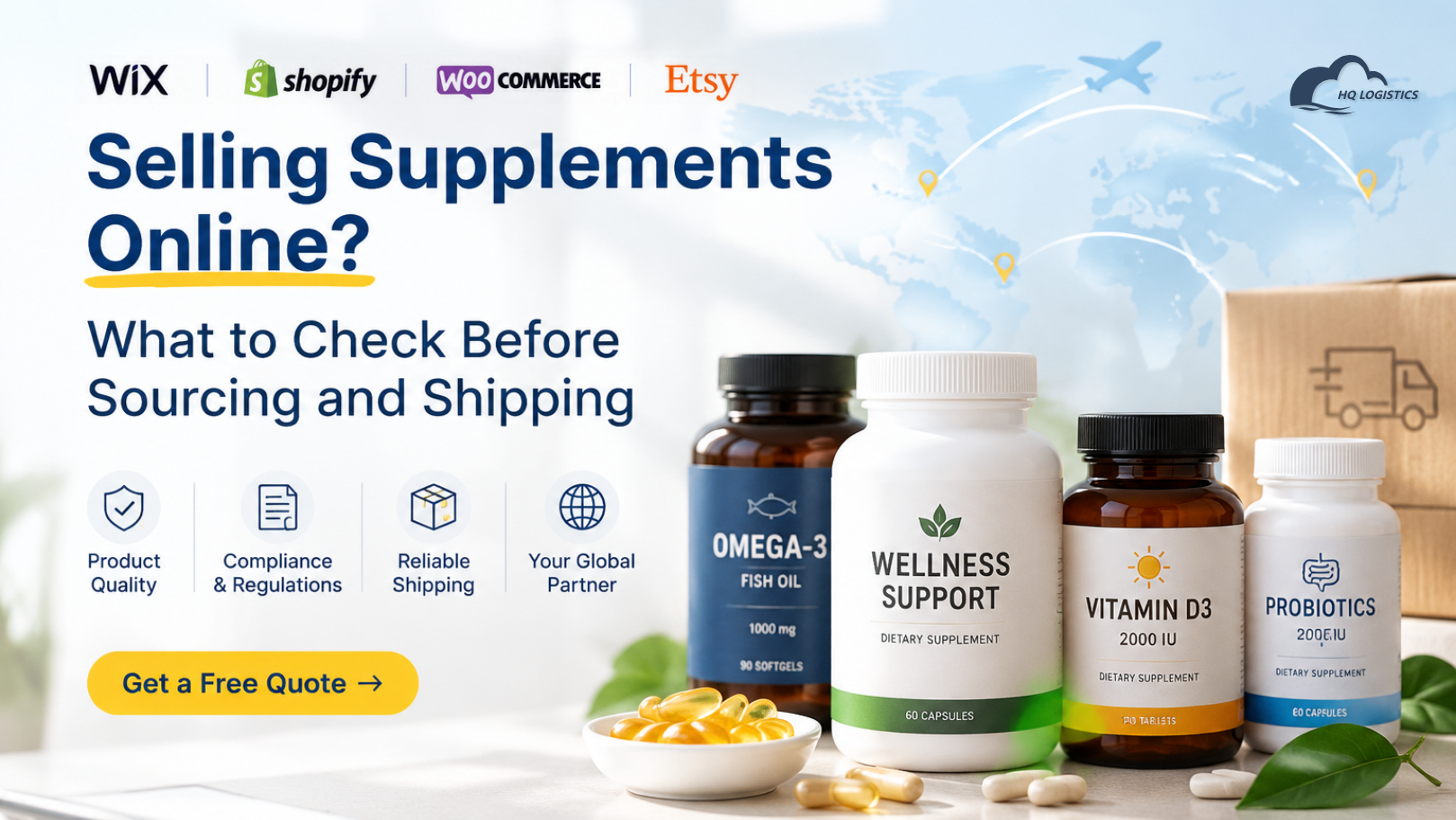
Selling Supplements Online? What to Check Before Sourcing and Shipping
Selling Supplements Online? What to Check Before Sourcing and Shipping
Selling supplements online can be an attractive opportunity for ecommerce brands. From vitamins and minerals to protein powders and wellness products, demand creates opportunities for sellers targeting health-conscious consumers. But supplements require more careful sourcing, quality control, packaging, and shipping than many ordinary ecommerce products.
Before launching a supplement product or scaling your existing store, you need to look beyond the supplier's price. Product compliance, ingredient documentation, shelf life, packaging integrity, and shipping restrictions can all affect your costs and customer experience.
In this guide, we'll cover what ecommerce sellers should check before sourcing and shipping supplements, and how the right fulfillment partner can help simplify the process.
1. Check Product Compliance Before Sourcing Supplements
Before choosing a supplement supplier, identify the markets where you plan to sell. Requirements can differ significantly between the United States, the United Kingdom, and European countries.
A product that can be sold in one market may require additional documentation, labeling changes, or regulatory review in another.
Here are several important checks to make before placing an order:
-
Ingredient list:
Review all ingredients, their quantities, and any restricted or prohibited substances in your target market. -
Product labeling:
Check whether the label meets local requirements for ingredient declarations, serving sizes, warnings, and other mandatory information. -
Health claims:
Ensure that product descriptions, advertising, and packaging claims comply with applicable rules. Avoid unsupported claims that a supplement can treat, prevent, or cure a disease. -
Supplier documentation:
Request relevant product specifications, certificates of analysis (COAs), and manufacturing or quality documentation. -
Import requirements:
Confirm whether the product can legally enter your destination country and whether additional permits, declarations, or registrations are needed.
For example, selling dietary supplements in the United States involves FDA requirements, while the EU has its own food supplement rules and country-specific considerations.
2. Evaluate Supplement Suppliers Beyond Price
A low unit price does not necessarily mean a lower total cost. If a supplier delivers inconsistent batches, incomplete documentation, or poorly packaged products, the resulting returns and customer complaints can quickly reduce your profit margin.
Before choosing a supplier, evaluate these factors.
Product Quality and Consistency
Ask whether the supplier has documented quality-control procedures and whether the product can be tested by a qualified laboratory when appropriate.
Depending on the product, relevant checks may include ingredient identity, potency, microbiological contamination, heavy metals, and other contaminants.
A certificate of analysis can be useful, but check that it matches the actual product and batch. Where necessary, verify the issuing laboratory and the scope of testing.
Manufacturing and Traceability
A reliable supplier should be able to explain how products are manufactured, identified by batch, and tracked through the supply chain.
Ask for information about:
-
Batch or lot numbers
-
Manufacturing and expiration dates
-
Storage conditions
-
Quality assurance procedures
-
Recall and complaint handling
-
Relevant manufacturing certifications
Certifications and quality systems can provide useful evidence, but they should be verified rather than accepted at face value.
Sample Inspection
Before committing to a large order, request samples and assess the product's appearance, packaging, labeling, and consistency with the approved specifications.
For established brands, repeatability matters. A product that meets your expectations in the first order should continue to meet the same standards in subsequent batches.
Working with a sourcing partner can help you compare suppliers, collect documentation, coordinate sample checks, and clarify product specifications before inventory moves into fulfillment.
3. Inspect Packaging, Seals, and Shelf Life
Supplement packaging protects product quality and influences customer confidence. Even a high-quality product can create problems if its container leaks, seal breaks, label becomes unreadable, or expiration date is too close to the customer's expected usage period.
Before shipping supplements, check the following.
Tamper-Evident Seals
Verify that safety seals, caps, and closures are intact and appropriate for the product. Damaged or missing seals should trigger a documented inspection process.
Labels and Batch Information
Check that product names, required warnings, batch numbers, and expiration dates are legible and consistent with approved specifications.
Protective Shipping Materials
Use suitable cushioning, dividers, and cartons to minimize movement, breakage, leakage, and damage during transportation.
Shelf Life and Storage
Confirm the remaining shelf life before dispatch and follow the manufacturer's specified temperature, humidity, and handling requirements.
For products with limited shelf life, inventory management is especially important. A first-expired, first-out (FEFO) process helps prioritize inventory with the earliest expiration dates, provided the stock is suitable for sale.
If you use a third-party warehouse, confirm that it can record batch and expiration information where required and support your stock rotation procedures.
4. Understand Supplement Shipping Restrictions
Shipping supplements internationally is not always as simple as shipping ordinary consumer goods. Product composition, dosage form, destination regulations, customs requirements, and carrier policies can all affect whether a shipment is accepted.
Before selecting a shipping route, confirm the following.
Destination-Specific Import Rules
Check whether the destination permits the specific supplement, ingredients, dosage form, and intended quantity. Some products may face additional restrictions or documentation requirements.
Do not assume that a route accepting vitamins will also accept every powder, liquid, herbal product, or concentrated formula.
Customs Documentation
Depending on the shipment and destination, documentation may include an accurate commercial invoice, product description, ingredient information, country of origin, and other required declarations.
Product descriptions should be truthful and sufficiently specific. Mislabeling supplements as ordinary goods to avoid inspection can lead to delays, penalties, or rejected shipments.
Carrier Acceptance
Ask your logistics provider to confirm acceptance of the exact product before dispatch. This is particularly important for powders, liquids, products containing unusual ingredients, and shipments subject to special handling conditions.
Delivery Time and Tracking
Compare delivery estimates, tracking availability, customs procedures, and the handling of delayed or returned parcels.
For ecommerce brands, reliable tracking helps customer service teams answer delivery questions and identify problems before they become larger issues.
Important:
Shipping eligibility must be verified for the specific product and destination. A route described as a supplement shipping service does not automatically guarantee customs clearance or unrestricted delivery.
5. Choose Between China Direct Shipping and an Overseas Warehouse
Your fulfillment model can affect delivery speed, inventory investment, operating costs, and the flexibility of your business.
Two common options are China direct shipping and overseas warehousing.
China Direct Shipping
China direct shipping can support flexible inventory management and help sellers test demand without committing large quantities of stock to overseas locations.
However, international transit times, customs procedures, and product eligibility must be considered. Before accepting customer orders, verify whether the specific supplement can be shipped through the selected route.
Overseas Warehouse
An overseas warehouse may offer faster local delivery and more consistent domestic fulfillment. This can be useful for established bestsellers with predictable demand.
Before moving supplements into overseas storage, confirm local import and storage requirements, product shelf life, and whether the warehouse can maintain appropriate conditions.
Some brands use a hybrid model: they test products through flexible fulfillment and move proven bestsellers into regional inventory when sales become more predictable.
The right choice depends on your product, sales volume, target market, and compliance obligations.
6. Calculate the True Cost of Supplement Fulfillment
Product cost and postage are only two parts of the total fulfillment expense. A more accurate calculation includes sourcing, quality checks, packaging, inventory handling, international transportation, customs-related costs, and potential returns.
Consider these cost categories before setting your retail price:
-
Product purchase and sourcing fees
-
Sample testing and quality inspection
-
Packaging materials and labeling
-
Warehouse receiving, storage, and order processing
-
International shipping and applicable duties or taxes
-
Returns, damaged parcels, and customer service
-
Inventory losses caused by expiration or unsold stock
For example, a supplier offering a lower unit price may not be the most cost-effective choice if the product requires extra testing, arrives with insufficient shelf life, or needs expensive packaging modifications.
Likewise, the cheapest shipping route may create higher overall costs if tracking is limited or delivery delays lead to refunds and reshipments.
A reliable sourcing and fulfillment process helps sellers evaluate the total cost per successfully delivered order rather than focusing on one low headline price.
7. Build a Reliable Supplement Fulfillment Workflow
As order volume increases, manual checks and disconnected systems become harder to manage. A consistent workflow can help reduce errors and improve visibility across sourcing, inventory, and delivery.
A practical process looks like this:
Supplier Verification → Product and Document Checks → Packaging Inspection → Inventory Recording → Route Confirmation → Order Fulfillment → Tracking and Customer Support
Each step serves a different purpose.
-
Supplier verification:
Confirm product specifications and relevant documentation. -
Product checks:
Inspect approved samples and establish acceptance criteria. -
Packaging inspection:
Check seals, labels, batch details, and shipping protection. -
Inventory recording:
Track quantities, batch numbers, and expiration dates where needed. -
Route confirmation:
Verify carrier acceptance and destination requirements. -
Order fulfillment:
Pick, pack, and dispatch orders according to documented procedures. -
Tracking and support:
Monitor shipments and resolve delivery or product issues efficiently.
For growing ecommerce brands, a fulfillment partner can coordinate several of these operational steps and provide clearer visibility into orders and inventory.
However, outsourcing logistics does not remove the seller's responsibility to ensure that supplements are compliant and suitable for sale in each target market. Regulatory obligations should be confirmed with qualified professionals when necessary.
8. How HQ LOGISTICS Supports Ecommerce Fulfillment
For ecommerce brands selling supplements, the right logistics partner should understand that product handling, shipping eligibility, and inventory visibility matter just as much as dispatch speed.
HQ LOGISTICS provides sourcing coordination, warehouse fulfillment, quality-check support, customized packaging options, order processing, and shipment tracking for ecommerce businesses.
Depending on the product and destination, our team can help sellers evaluate suitable shipping options and coordinate fulfillment requirements before orders are dispatched.
When assessing a potential supplement fulfillment partner, ask about:
-
Product acceptance procedures for your specific supplement
-
Available quality-inspection and packaging checks
-
Batch and expiration-date recording capabilities
-
Warehouse storage conditions
-
Shipping routes, tracking, and delivery estimates
-
Inventory and order management integrations
These questions can help you determine whether a partner's services match your product requirements and business model.
If you're preparing to launch a supplement brand or scale an existing online store, contact HQ LOGISTICS to discuss your sourcing and fulfillment needs: https://hqfulfillment.com/.
FAQs About Sourcing and Shipping Supplements
1. Can I Dropship Supplements from China to the US or Europe?
Potentially, but eligibility depends on the exact product, ingredients, destination requirements, and carrier policies. Verify regulatory compliance and route acceptance before listing the product or accepting customer orders.
2. What Documents Should I Request from a Supplement Supplier?
Depending on the product and market, useful documents may include product specifications, a certificate of analysis, ingredient information, batch records, manufacturing or quality certifications, and relevant compliance documentation. No single document guarantees that a product is legally marketable in every country.
3. How Can I Reduce the Risk of Damaged Supplement Shipments?
Use suitable containers, intact seals, protective packaging, and cartons sized for the shipment. Validate packaging against expected handling conditions and inspect products before dispatch.
4. Should I Use an Overseas Warehouse for Supplements?
An overseas warehouse may be suitable for established products with predictable demand and sufficient remaining shelf life. Before sending inventory, confirm local compliance, storage conditions, stock rotation capabilities, and the total cost of holding inventory.
5. What Should I Look for in a Supplement Fulfillment Partner?
Prioritize product acceptance procedures, suitable storage and packaging, inventory visibility, traceability capabilities, route verification, and responsive customer support. The partner should be able to explain which services it provides and which compliance responsibilities remain with your business.

Final Thoughts
Selling supplements online requires more than finding a competitive supplier and a low shipping rate. Product compliance, supplier verification, quality control, packaging integrity, shelf life, and destination-specific shipping requirements all contribute to a sustainable ecommerce operation.
Before scaling your supplement business, build a process that checks the product from sourcing through final delivery. Choose suppliers carefully, verify shipping eligibility, and work with fulfillment partners who can support your operational needs.
Planning to sell supplements online?
HQ LOGISTICS can help you explore sourcing coordination, warehouse fulfillment, packaging, and shipping options for your ecommerce business. Contact our team to discuss your product and target markets.OUR WEBSITE:
https://www.cnfulfillment.com/
 selling supplements online, supplement sourcing, supplement shipping, supplement fulfillment, dietary supplement suppliers, supplement quality control, supplement packaging, dropshipping supplements from China, ecommerce supplement fulfillment, supplement shipping to the US and Europe, China fulfillment center, HQ LOGISTICS